Active Propulsion in Complex Fluids
Active particles
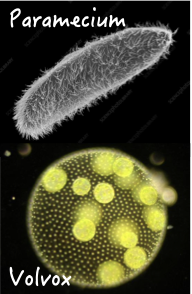
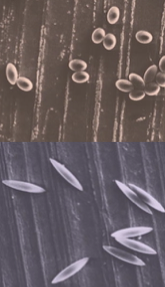
Trevenen & Beltramo, J. Colloid Interface Sci., 2021
Convert energy into autonomous motion
Complex-fluid environments

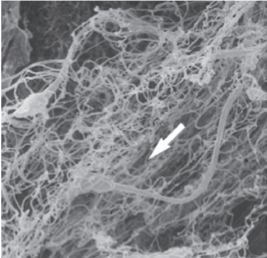
Chrétien, Acta Obstet. Gynecol. Scand., 2003
Often exhibit non-Newtonian rheology
How does fluid rheology alter active propulsion?
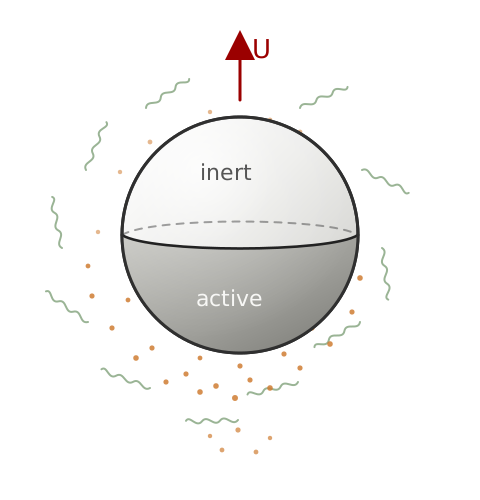
How Does a Janus Particle Propel Itself?
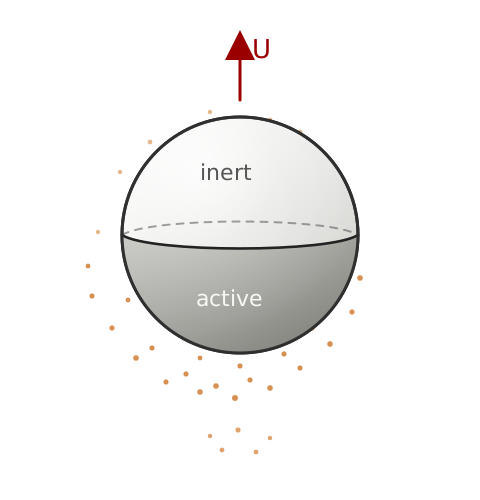
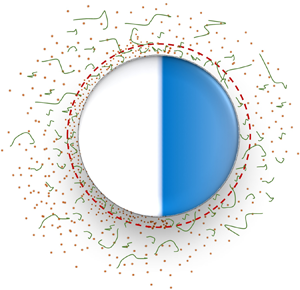
Chemical reaction
creates an uneven solute concentration
Surface concentration gradient
generates a thin surface flow (slip)
Asymmetric slip
produces net propulsion
Self-diffusiophoresis: asymmetric activity → solute gradient → surface slip → propulsion
How Does a Janus Particle Propel Itself?
What happens when these particles move in complex fluids?
Self-diffusiophoresis: asymmetric activity → solute gradient → surface slip → propulsion
Complex Fluids Change Particle Dynamics
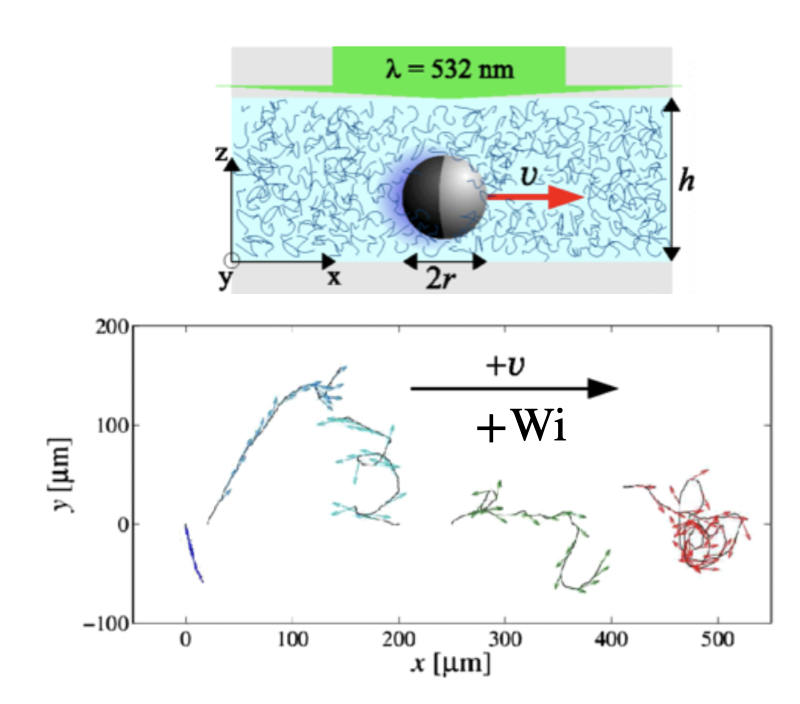
Enhanced rotational fluctuations
Gomez-Solano et al., PRL, 2016
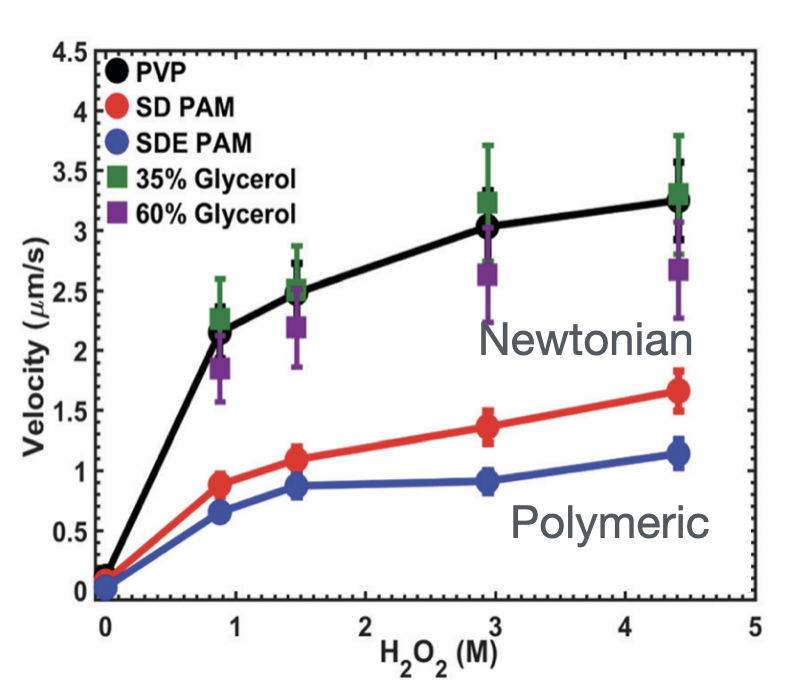
Reduced propulsion
Saad & Natale, Soft Matter, 2019
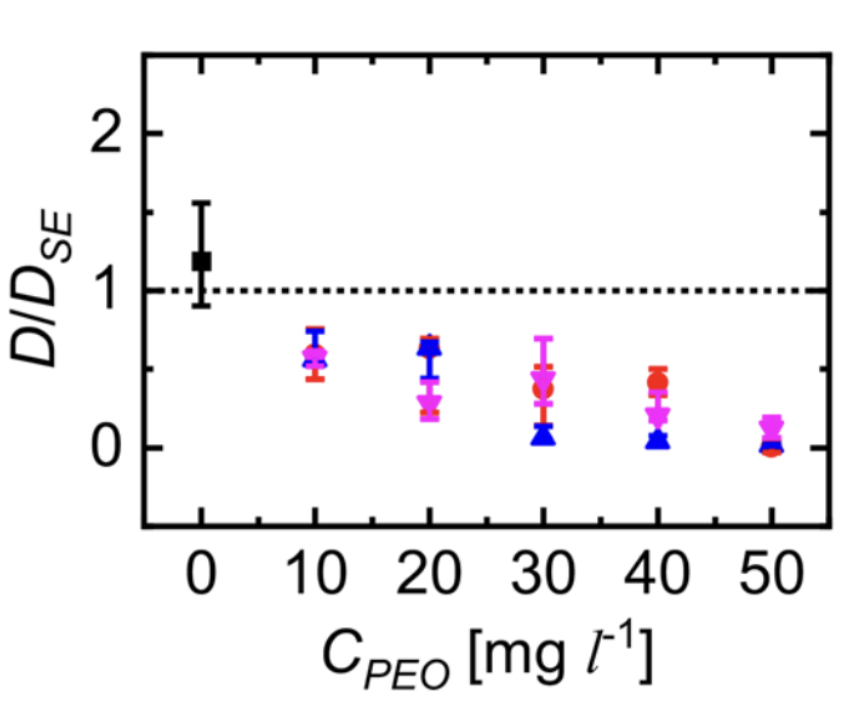
Suppressed active motion
Raman et al., ACS Phys. Chem. Au, 2023
Experiments reveal diverse responses, but the direct rheological effect on propulsion remains unclear.
Two Common Rheological Effects
Shear thinning
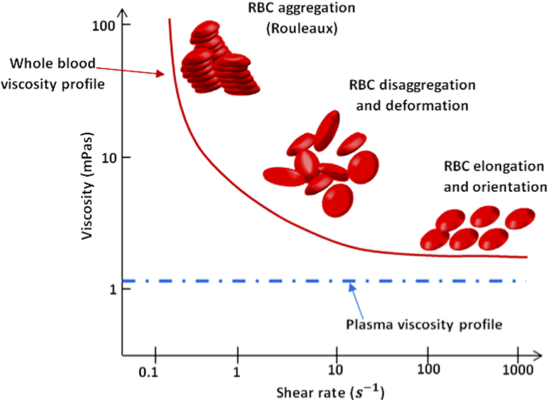
Méndez-Mora et al., Micromachines 12, 726 (2021)
Higher shear rate → lower viscosity
Viscoelasticity
Chrétien, Acta Obstet. Gynecol. Scand., 2003
Deformation → relaxation
These two rheological effects can coexist in the same complex fluid.
Spherical Particles: What Does Theory Predict?
Shear thinning
Carreau model
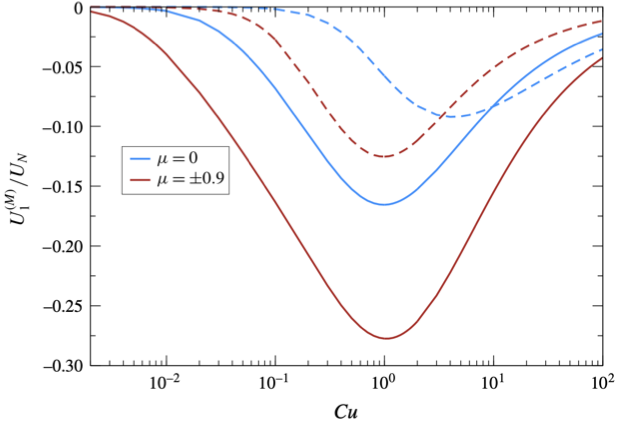
Sphere: propulsion is reduced
Viscoelasticity
Second-order fluid
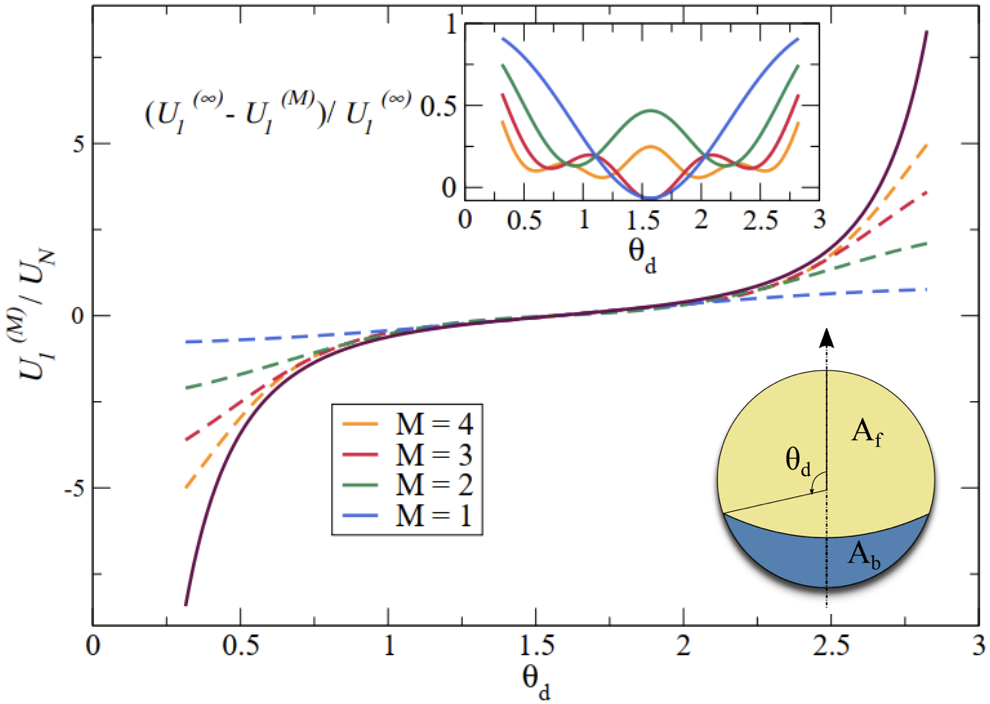
Half-coated sphere: leading-order correction vanishes
Datt et al., J. Fluid Mech., 2017
From Spheres to Spheroids
Sphere — correction vanishes at half-coating
?
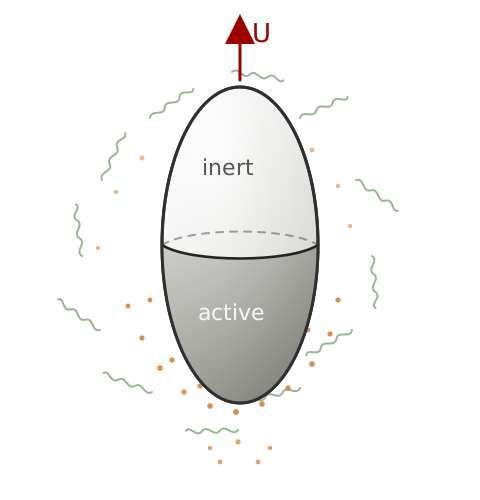
Spheroid — geometric anisotropy
We vary two control parameters: eccentricity \(e\) (shape) and coverage \(\zeta_0\) (activity).
Model: A Spheroidal Self-Diffusiophoretic Particle
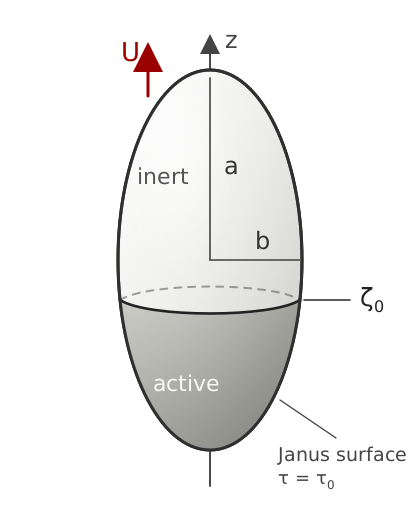
- Solve the concentration and flow fields in prolate spheroidal coordinates \((\tau,\zeta)\)
- Shape parameter: eccentricity \(e=\sqrt{a^2-b^2}/a\)
- Activity parameter: catalytic coverage \(\zeta_0\)
Concentration Gradients Drive Surface Slip

Surface flux \(\to\) Concentration field
\[ \frac{\partial C}{\partial t} + \boldsymbol{u}\cdot\nabla C = D\nabla^2 C, \quad \left. D\boldsymbol{n}\cdot\nabla C \right|_{\tau=\tau_0,\zeta<\zeta_0} = -A \]
\(C\): solute concentration; \(\boldsymbol{u}\): fluid velocity; \(D\): solute diffusivity; \(A\): surface activity / fixed solute flux on the active cap; \(\boldsymbol{n}\): unit normal.
Tangential gradient \(\to\) Phoretic slip
\[ \boldsymbol{u}_s = M(\boldsymbol{I}-\boldsymbol{n}\boldsymbol{n})\cdot \nabla C \]
\(M\): phoretic mobility; \((\boldsymbol{I}-\boldsymbol{n}\boldsymbol{n})\): tangential projection operator.
Slip velocity \(\to\) Force-free propulsion
\[ \boldsymbol{u}(\tau=\tau_0) = \boldsymbol{u}_s(\zeta)+\boldsymbol{U}, \]
\[ \int_S \boldsymbol{n}\cdot\boldsymbol{\sigma}\,\mathrm{d}S = \boldsymbol{0} \]
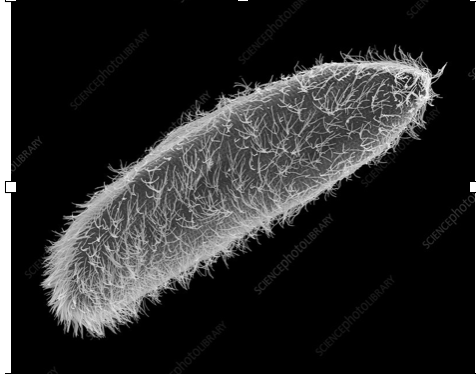
biological propulsion analogy
Diffusion-Dominated Solute Transport
Diffusion-dominated limit: \(Pe=\dfrac{MAa}{D^2}\) — advection / diffusion
\[ Pe\ll1 \;\Rightarrow\; \nabla^2 c=0, \qquad \left.\boldsymbol{n}\cdot\nabla c\right|_{\tau=\tau_0} = \begin{cases} -1, & \zeta\le \zeta_0 \quad \text{active},\\ 0, & \zeta>\zeta_0 \quad \text{inert}, \end{cases} \qquad c|_{\tau\to\infty}=0 \]
\(c\): dimensionless relative solute concentration; \(\tau=\tau_0\): particle surface.
Series solution and induced slip
\[ c(\tau,\zeta) = \sum_{n=0}^{\infty} \rho_n Q_n(\tau)P_n(\zeta) \]
\[ \implies u_s(\zeta) = \tau_0\sum_{n=1}^{\infty} B_n\frac{P_n^1(\zeta)}{\sqrt{\tau_0^2-\zeta^2}} \]
\(P_n,Q_n\): Legendre functions; \(\rho_n\): coefficients set by the flux boundary condition; \(B_n=-\rho_n Q_n(\tau_0)\).
Note: finite-\(\mathrm{Pe}\) coupling
Finite \(Pe\): advection couples the solute and flow fields, allowing rheology to modify the concentration field and hence the phoretic slip.
Newtonian Baseline
Weakly non-Newtonian: expand in \(\epsilon\ll 1\)
Shear thinning (Carreau): \(\epsilon = 1-\beta\)
Viscoelasticity (second-order fluid): \(\epsilon = \mathrm{De}\)
\[ \{\mathbf u,p,U\} = \{\mathbf u_0,p_0,U_0\} + \epsilon\{\mathbf u_1,p_1,U_1\} + O(\epsilon^2) \]
The zeroth order is the Newtonian problem, valid for any eccentricity, with a known speed:
\[ U_0 = -\frac{\tau_0}{2} \int_{-1}^{1} u_s \frac{\sqrt{1-\zeta^2}}{\sqrt{\tau_0^2-\zeta^2}} \,\mathrm{d}\zeta \]
Poehnl et al., J. Phys.: Condens. Matter, 2020; Popescu et al., Eur. Phys. J. E, 2010
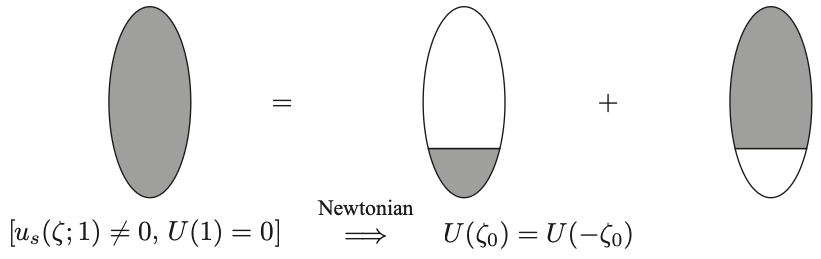
Linearity makes the Newtonian speed symmetric about half-coating: \(U_0(\zeta_0)=U_0(-\zeta_0)\).
Geometry Can Reverse the Effect of Shear Thinning
Half-coated particles: \(\zeta_0=0\)
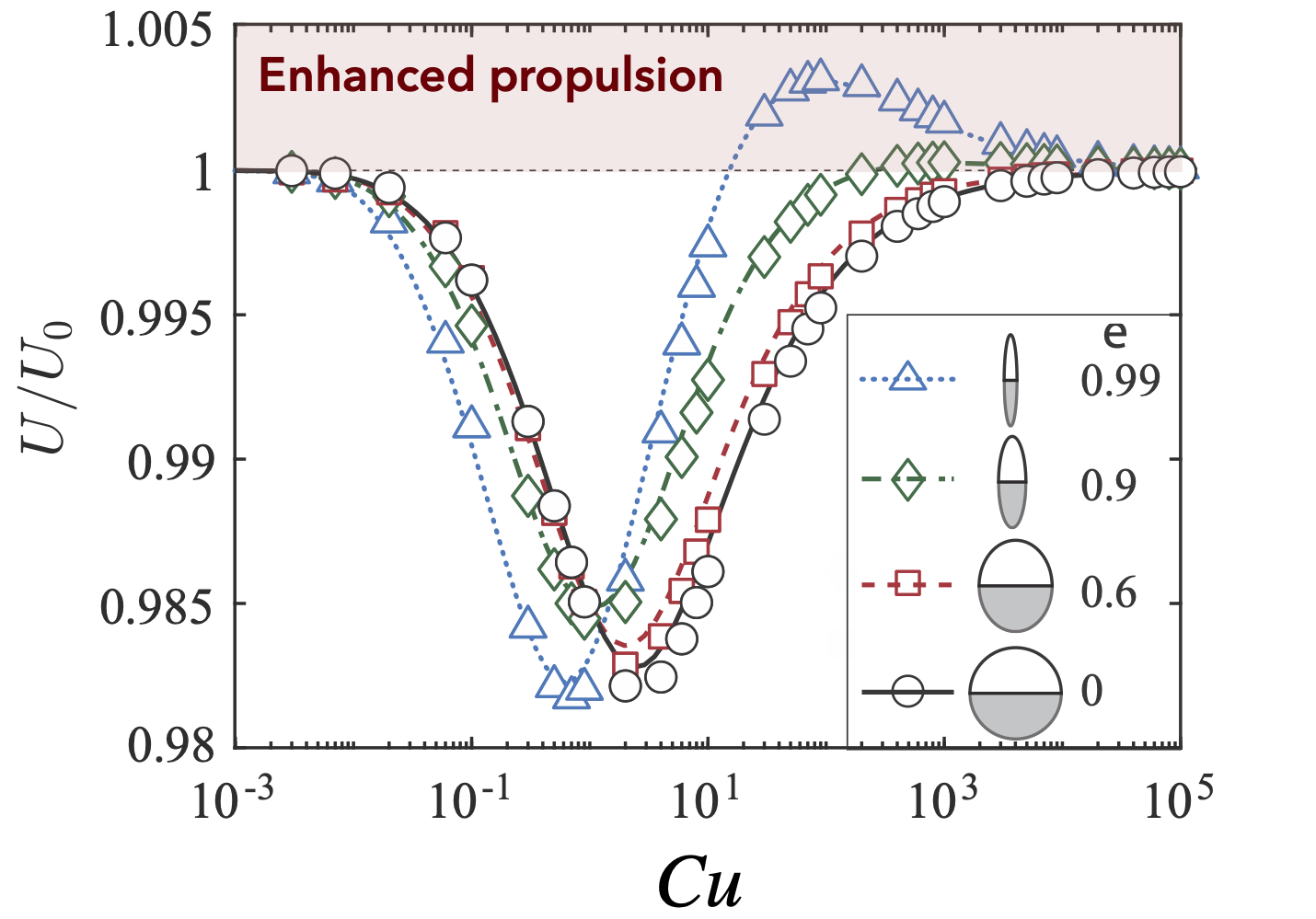
- Sphere: propulsion is always reduced
- Slender spheroids: propulsion can be enhanced
- Shape can reverse the rheological effect
G. Zhu, B. vanGogh, L. Zhu, O.S. Pak and Y. Man. JFM., 2024.
Geometry Breaks the Coverage Symmetry
Sphere
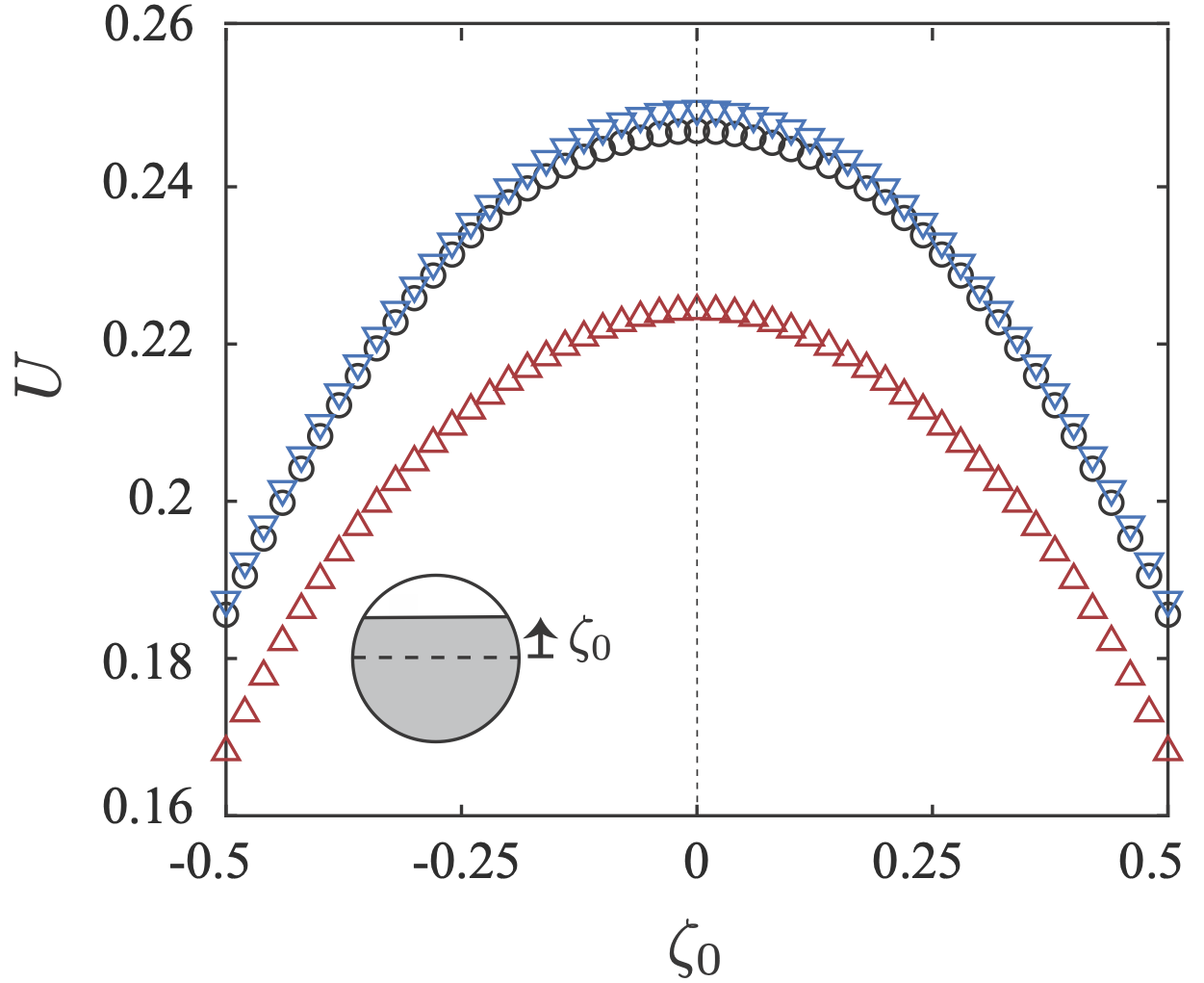
Complementary coatings → same speed
Spheroid
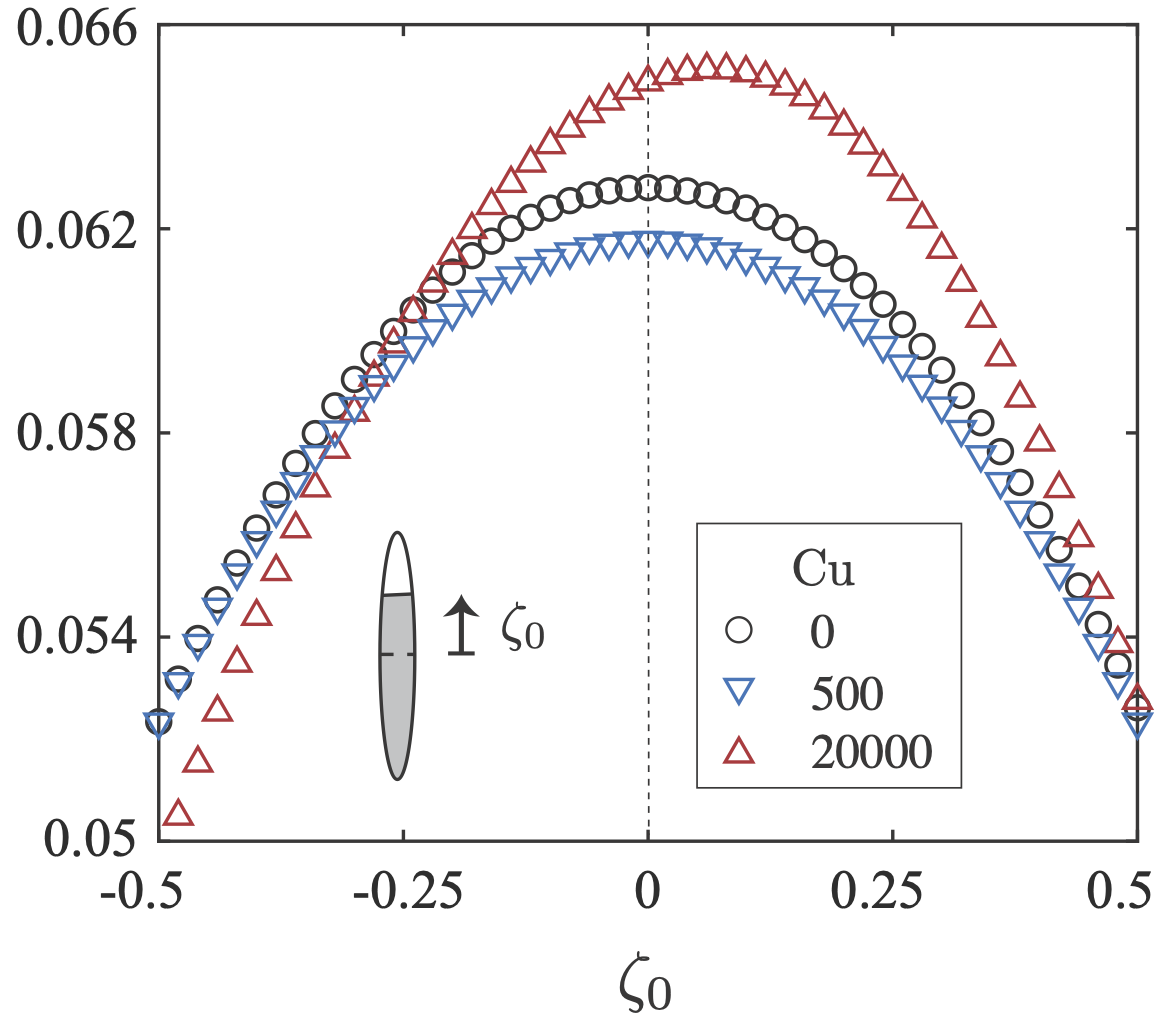
Complementary coatings → different speeds
Geometry breaks the complementary-coating symmetry.
Why the Coverage Symmetry Breaks
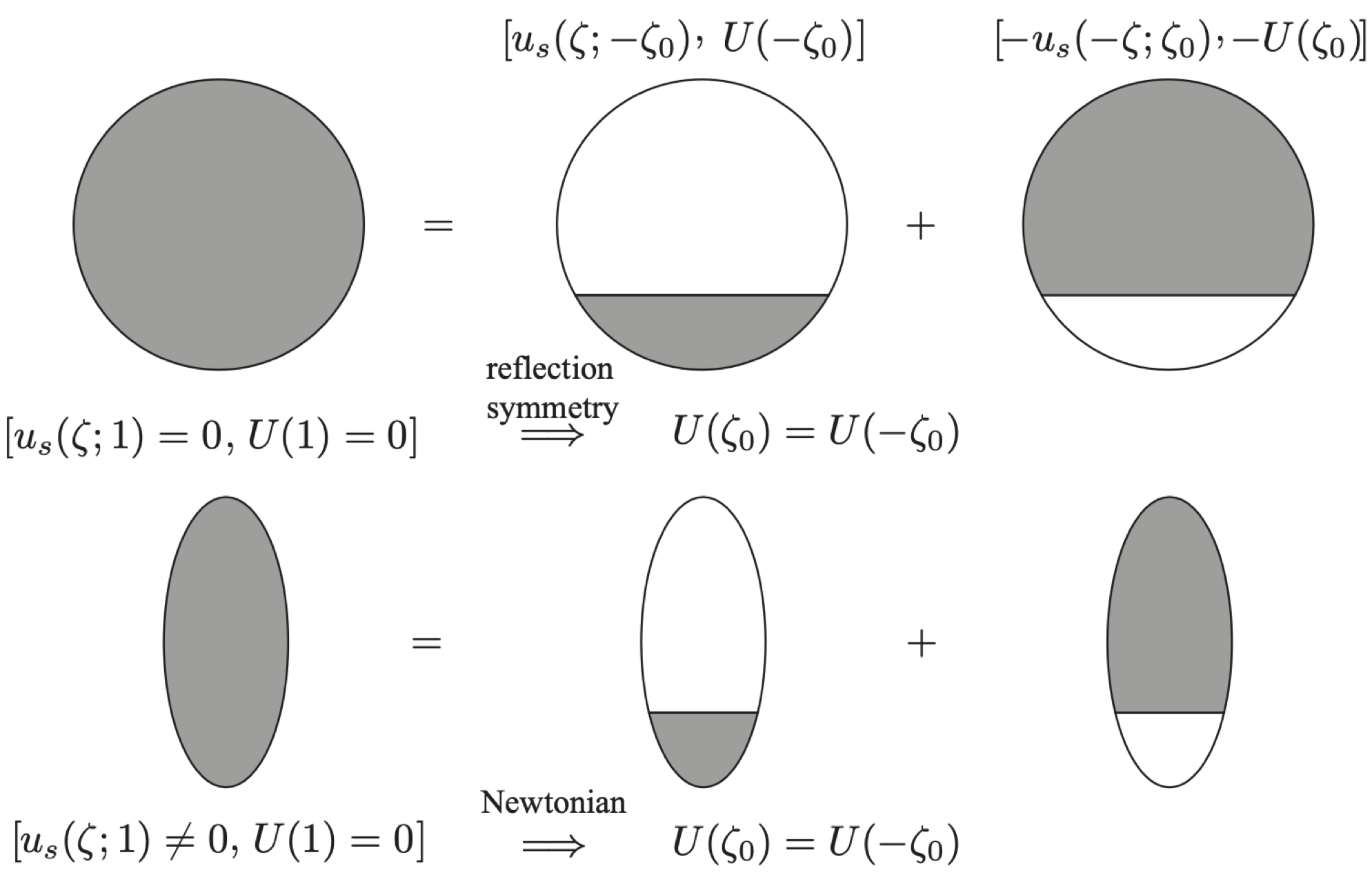
Symmetry breaking requires both geometric anisotropy and nonlinear rheology.
Eccentricity Revives the Correction
Half-coated particles: \(\zeta_0=0\)
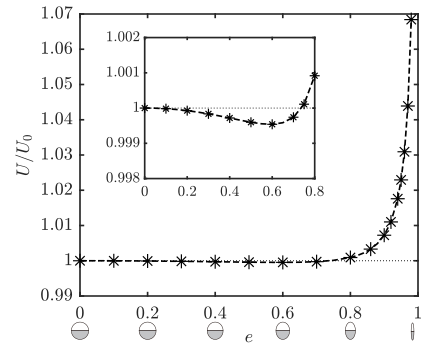
- Sphere → zero correction by symmetry
- Increasing eccentricity → symmetry broken
- Slender limit → strong propulsion enhancement
Q. Zhao, G. Zhu and Y. Man. (submitted).
Breaking the Coverage Symmetry
Propulsion vs Coverage
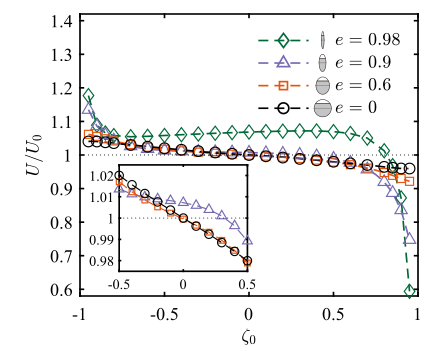
Enhancement vs Reduction
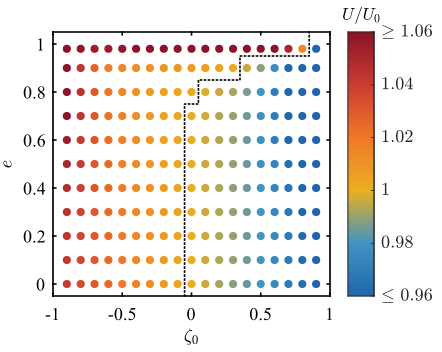
Eccentricity breaks the coverage antisymmetry, and the enhancement regime broadens with elongation.
Why the Cancellation Breaks
- The first-order speed is set by a local kernel: \(U_1 \propto \int_V\) 𝒦 \(\mathrm{d}V\), where 𝒦 \(= \boldsymbol{A}:\nabla\hat{\boldsymbol{u}}\) (blue enhances, red reduces)
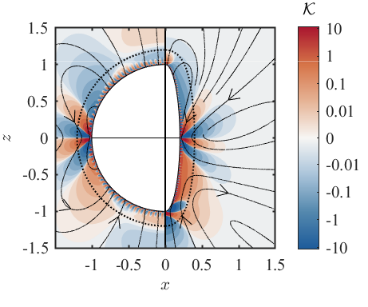
Sphere — 𝒦 antisymmetric, cancels exactly ⟹ \(U_1=0\)
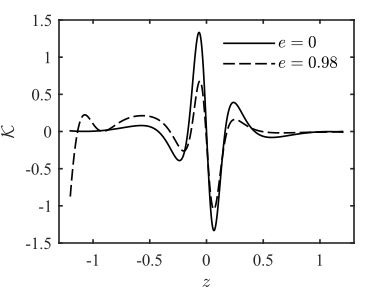
Spheroid — curvature localizes 𝒦, antisymmetry broken ⟹ \(U_1\neq0\)
Summary
Geometry can qualitatively change non-Newtonian propulsion.
- Shear thinning: Elongation can turn propulsion reduction into enhancement and break the complementary-coating symmetry.
- Viscoelasticity: Elongation can produce strong propulsion enhancement and break the coverage antisymmetry.
Acknowledgements
Qiang Zhao (赵强)
Peking University
Guangpu Zhu (朱光普)
Nanjing University of Aeronautics and Astronautics
Prof. On Shun Pak
Santa Clara University