Research Topics
Bacterial circling in complex fluids
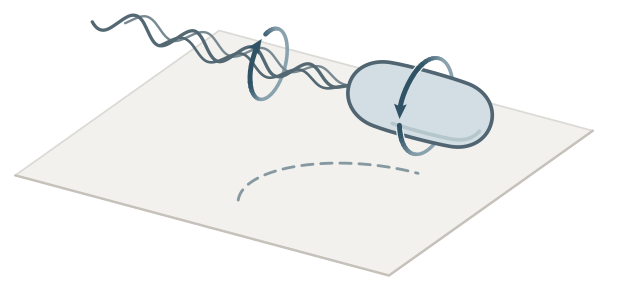
Flagellated bacteria such as E. coli often swim in circles near solid surfaces. As the flagellar bundle spins to propel the cell forward, the cell body rotates the other way. Near a wall, fluid drag pushes the body and the bundle sideways in opposite directions, causing the cell to turn as it swims. We study how fluid rheology shapes these near-wall trajectories.
Janus particle propulsion in complex fluids
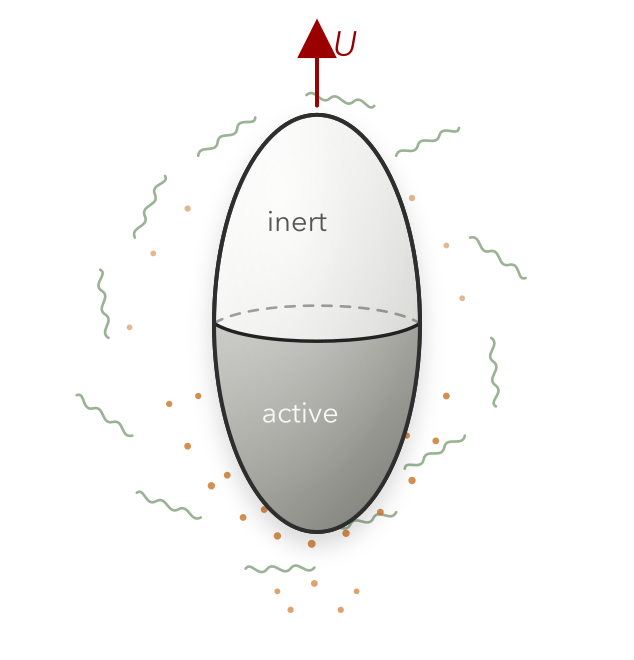
Janus particles are a widely studied model system for self-propulsion. A common example is a particle with a catalytic coating on just one side. This asymmetry allows a surface reaction to propel it through the surrounding fluid. We study how particle shape affects swimming speed in complex fluids.